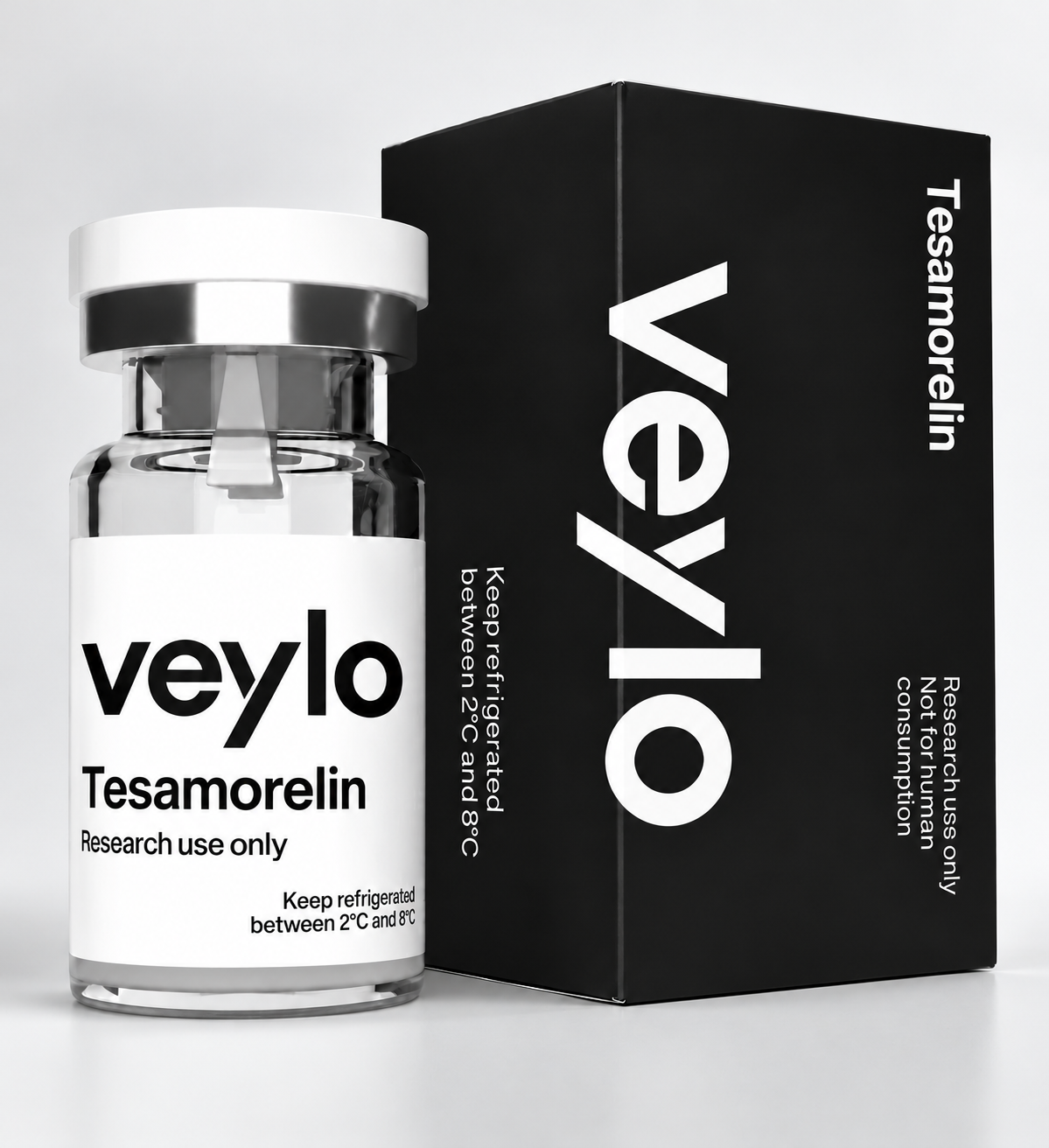
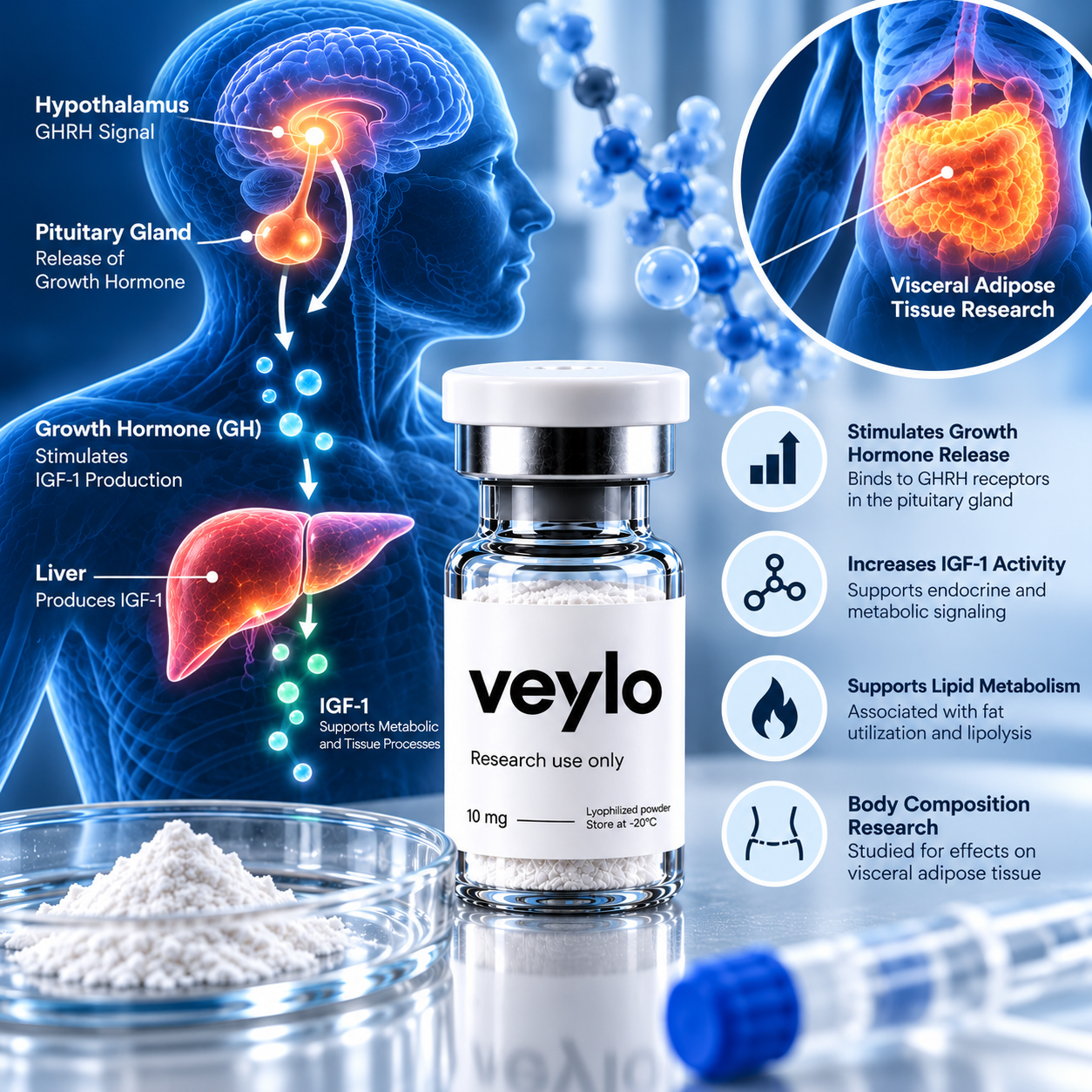
Tesamorelin is a synthetic peptide analog of growth hormone–releasing hormone (GHRH) that has been studied for its effects on growth hormone signaling, insulin-like growth factor 1 (IGF-1) activity, and body-composition-related metabolic pathways.
Because it interacts with the endocrine system through a defined receptor-mediated mechanism, tesamorelin has become a useful subject in research involving pituitary signaling, lipid metabolism, and hormone-regulated physiological responses.
This article provides a research-focused overview of tesamorelin, including its molecular role, mechanism of action, and the main areas in which it has been investigated.
Tesamorelin is a synthetic peptide designed as an analog of growth hormone–releasing hormone.
GHRH is a naturally occurring hypothalamic peptide that stimulates the pituitary gland to release growth hormone.
Tesamorelin mimics this signaling activity by binding to GHRH receptors in the anterior pituitary.
This interaction can lead to increased secretion of endogenous growth hormone, which may then influence downstream pathways including hepatic production of IGF-1.
Because of this mechanism, tesamorelin is often studied in relation to endocrine signaling rather than as a simple direct-acting peptide.
Tesamorelin works by stimulating the body’s own growth hormone axis.
Its biological activity begins when it binds to GHRH receptors located on pituitary somatotroph cells.
This receptor activation initiates intracellular signaling that promotes the release of growth hormone.
Growth hormone then acts on multiple tissues and also stimulates production of IGF-1, primarily in the liver.
Researchers study tesamorelin because this pathway is relevant to:
Unlike exogenous growth hormone, tesamorelin acts upstream in the signaling pathway.
This distinction is important in research because it may influence the pattern and regulation of hormone release.
The growth hormone axis is a tightly regulated system involving the hypothalamus, pituitary gland, liver, and peripheral tissues.
In this system:
Tesamorelin is studied because it engages this natural signaling cascade.
Researchers examine whether stimulating this pathway affects metabolic markers, tissue responses, and hormone-related physiological changes.
This also makes tesamorelin useful for studying how endocrine signaling influences body composition and nutrient metabolism.
A major part of tesamorelin research involves insulin-like growth factor 1.
IGF-1 is a signaling molecule associated with growth hormone activity and participates in a wide range of biological processes, including tissue growth, cellular regulation, and metabolic function.
When tesamorelin stimulates growth hormone release, IGF-1 levels may also increase.
Researchers often measure IGF-1 as a downstream marker when evaluating the biological activity of tesamorelin.
Scientific interest in this pathway includes:
However, interpretation depends on the design of the study, the population examined, and the duration of exposure.
One of the most common areas of tesamorelin investigation involves body composition.
Body composition research examines the relative distribution of fat mass, lean tissue, and other structural components of the body.
Tesamorelin has been studied in this context because growth hormone signaling can influence lipid metabolism and adipose tissue biology.
Visceral adipose tissue refers to fat stored within the abdominal cavity around internal organs.
It has distinct metabolic characteristics compared with subcutaneous fat.
Researchers have investigated tesamorelin in studies focused on changes in visceral adipose tissue because this fat compartment is associated with important metabolic processes.
Growth hormone signaling may affect lipolysis, which is the breakdown of stored fats into usable substrates.
Tesamorelin-related research has therefore examined whether stimulating the GH axis produces measurable changes in lipid handling and related biomarkers.
These investigations are useful in understanding broader metabolic regulation, though outcomes vary depending on study design and population.
Tesamorelin has also been evaluated in human clinical research, particularly in relation to body composition and endocrine responses.
A major area of study has involved HIV-associated lipodystrophy, especially excess abdominal visceral fat accumulation.
In that setting, tesamorelin has been investigated for its effects on visceral adipose tissue and related metabolic parameters.
Researchers have also examined:
Clinical findings have contributed to scientific understanding of how GHRH analogs influence metabolism and hormone-regulated tissue responses.
Lipid metabolism is another important area of tesamorelin research.
Growth hormone signaling can influence how the body stores and mobilizes fat.
Researchers study tesamorelin to better understand how GHRH receptor activation may affect:
These effects are especially relevant in research involving abdominal fat distribution and endocrine-metabolic interactions.
However, lipid metabolism is influenced by many factors, including nutrition, baseline physiology, concurrent conditions, and other hormonal systems.
Because tesamorelin acts within the endocrine system, it is also studied in relation to hormone feedback and regulation.
The GH/IGF-1 axis is subject to feedback control, meaning that changes in downstream signaling can influence upstream hormone release.
Researchers may investigate tesamorelin in relation to:
This makes tesamorelin scientifically interesting not only as a peptide compound but also as a model for studying hormonal control systems.
As with many research peptides, interpreting tesamorelin data requires attention to several important factors.
Responses may differ depending on the population studied, such as healthy subjects versus individuals with specific metabolic or endocrine conditions.
Different studies may use different dosing schedules and treatment durations, which can influence results.
Growth hormone secretion is naturally pulsatile and can be affected by sleep, age, stress, nutrition, and other physiological factors.
Measurements such as IGF-1 are useful, but they represent only part of the broader endocrine response.
A finding observed in a controlled study should not automatically be generalized beyond the conditions in which it was measured.
These factors are important when reviewing claims or comparing study results.
Reliable research depends on well-characterized materials.
When working with tesamorelin in laboratory or analytical settings, researchers may evaluate:
Techniques such as High-Performance Liquid Chromatography (HPLC) and Mass Spectrometry (MS) are commonly used to help characterize peptide materials.
Analytical quality supports more reliable interpretation of research findings, especially when comparing batches or reviewing test data.
A reported purity value can be useful, but it does not independently establish biological potency, sterility, or suitability for any specific application.
Although tesamorelin has been studied more extensively than many investigational peptides, limitations still exist.
Results from one clinical or research population may not apply to all others.
Because tesamorelin works through the endocrine system, observed effects may involve multiple interacting pathways.
Changes in IGF-1 or body composition markers should always be interpreted within the context of the study design.
Differences in analytical quality, formulation, and methodology can affect outcomes across studies.
These limitations do not reduce the value of the research, but they do highlight the need for careful interpretation.
Tesamorelin is a synthetic GHRH analog that has become an important subject in research involving the growth hormone axis, IGF-1 signaling, lipid metabolism, and body composition.
Its mechanism of action makes it especially useful for studying pituitary-mediated endocrine pathways and their downstream metabolic effects.
Research has explored its role in visceral adipose tissue, hormone regulation, and broader metabolic biology.
As with any peptide studied in laboratory or clinical contexts, meaningful interpretation depends on study quality, analytical characterization, and careful attention to biological context.
Research Use Disclaimer: This article is intended for educational and scientific informational purposes only. Tesamorelin is discussed here in a research context. Nothing in this article should be interpreted as medical advice, treatment guidance, or a recommendation for human or veterinary use.