Proper storage and handling are essential factors in maintaining the integrity of research peptides. Because peptides are composed of amino acid sequences with different chemical characteristics, their stability can vary considerably depending on environmental conditions and molecular structure.
Temperature, moisture, light exposure, and solution composition can all influence peptide stability over time.
Understanding these factors helps researchers preserve sample quality, reduce experimental variability, and maintain reliable laboratory results.
This guide explores the principles of peptide storage, common degradation mechanisms, and important considerations for maintaining research materials under controlled laboratory conditions.
Why Is Peptide Stability Important?
Peptide stability refers to the ability of a peptide to maintain its chemical structure and relevant properties over time.
When a peptide undergoes degradation, its molecular composition may change. These changes can affect analytical measurements, molecular interactions, and experimental observations.
For example, a degraded sample may contain additional chemical species that were not present in the original material.
Such changes can complicate the interpretation of research findings.
Maintaining suitable storage conditions helps minimize unwanted chemical reactions and supports consistency between experimental samples.
Understanding Lyophilized Peptides
Lyophilization, commonly known as freeze-drying, is a process used to remove water from a material under controlled conditions.
Many synthetic research peptides are supplied in lyophilized form because removing water can reduce certain degradation reactions.
The resulting material may appear as a powder, porous solid, or compact residue, depending on the formulation and manufacturing process.
Why Is Lyophilization Used?
Lyophilization can provide several advantages for laboratory research materials:
- Reduced exposure to water-dependent degradation reactions
- Improved stability for suitable peptide formulations
- Easier handling and transportation of dry materials
- Greater flexibility in preparing samples for specific experiments
However, lyophilization does not make a peptide indefinitely stable.
Some sequences remain susceptible to oxidation, moisture absorption, and other chemical changes even in the dried state.
How Temperature Affects Peptide Stability
Temperature plays an important role in the rate of chemical reactions.
For many peptides, elevated temperatures can accelerate degradation processes and reduce long-term sample stability.
Consequently, research laboratories frequently use controlled refrigeration or freezing conditions for peptide materials.
Refrigerated Storage
Refrigeration may be appropriate for certain peptides during short-term laboratory storage.
However, not all peptide formulations maintain sufficient stability under refrigerated conditions.
The suitability of refrigeration depends on the peptide sequence, formulation, storage duration, and available stability data.
Frozen Storage
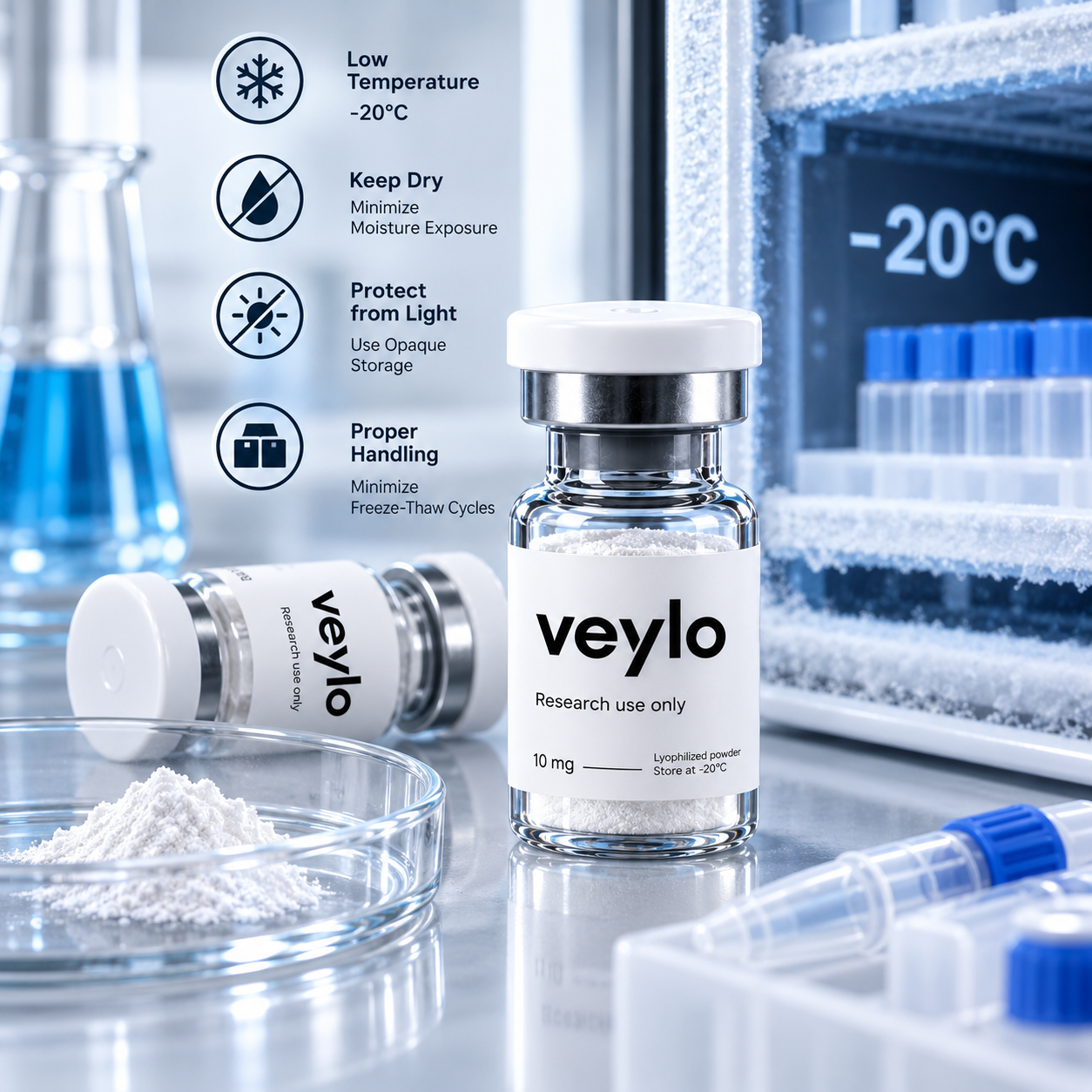
Many suppliers recommend storing lyophilized research peptides at approximately -20°C or colder for longer-term preservation.
Some materials may require lower temperatures depending on their chemical characteristics and validated storage requirements.
These recommendations should not be treated as universal rules.
Researchers should follow compound-specific documentation and establish storage conditions appropriate for their particular material.
The Role of Moisture in Peptide Degradation
Moisture exposure is another important consideration, particularly for lyophilized peptides.
Some amino acid sequences are hygroscopic, meaning they can a