
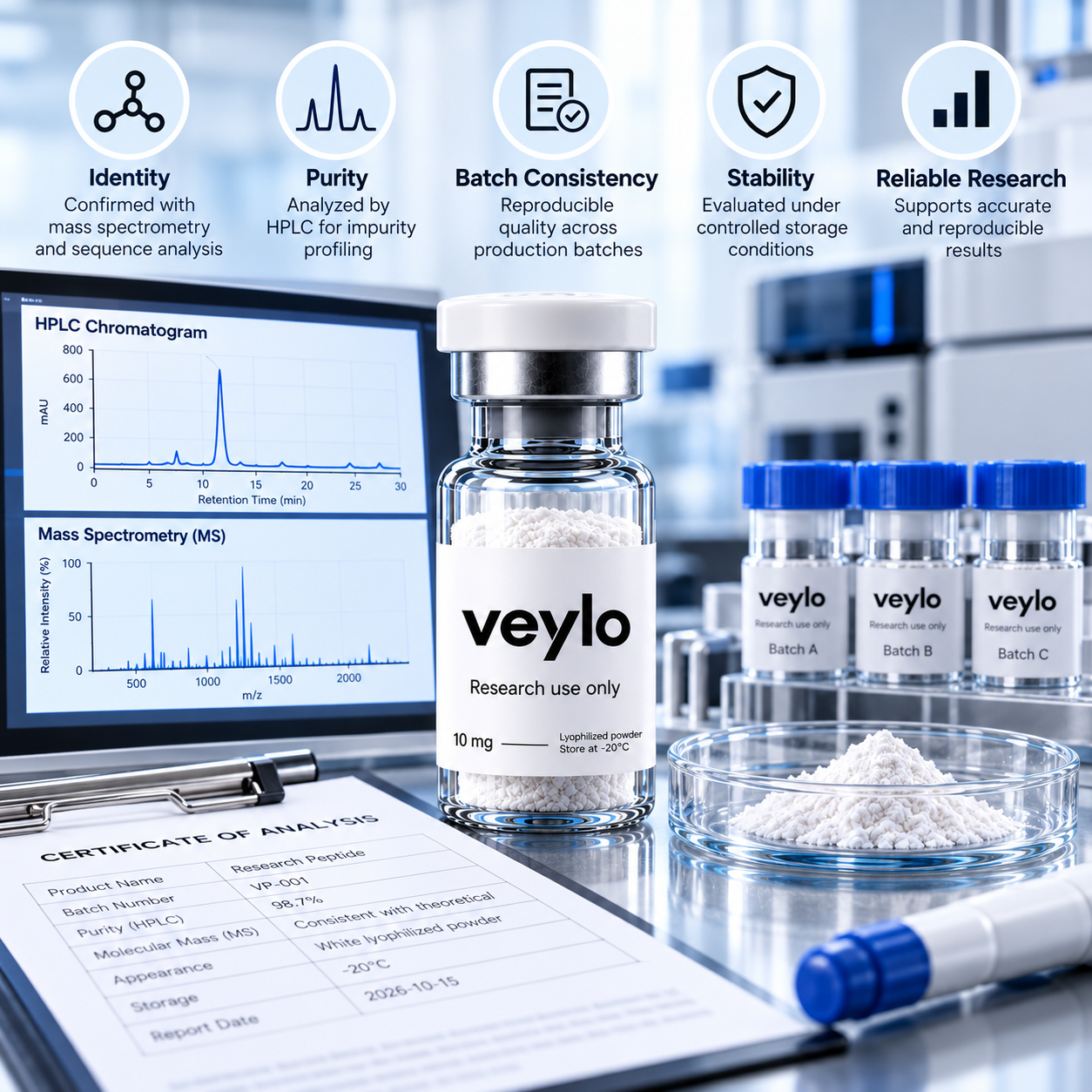
Quality control is an essential component of reliable peptide research. Whether peptides are used in biochemical analysis, molecular investigations, or experimental laboratory studies, understanding their composition and consistency helps researchers produce meaningful results.
Synthetic peptides are manufactured through processes that can introduce impurities, chemical modifications, and variations between production batches. These differences may affect experimental observations, making appropriate analytical characterization an important part of scientific research.
Peptide quality control involves evaluating several characteristics, including molecular identity, chemical purity, peptide content, stability, and batch-to-batch consistency.
This article explores the principles of peptide quality control, common analytical techniques, and the importance of maintaining consistent research materials.
Peptide quality control refers to the analytical processes used to evaluate the characteristics of peptide materials.
Its purpose is to determine whether a peptide sample meets defined specifications relevant to its intended application.
Because peptides consist of amino acids arranged in specific sequences, even relatively small structural differences can influence their chemical and biological properties.
Quality control therefore involves more than simply measuring the amount of peptide present in a sample.
A comprehensive analytical assessment may examine:
The right combination of tests depends on the peptide and the research application’s requirements.
Laboratory investigations depend on controlled experimental conditions.
When research materials vary unexpectedly, interpreting experimental results becomes more difficult.
For example, two peptide samples with the same stated identity may yield different results if they contain different impurities or have been stored under different conditions.
These differences may introduce uncertainty into experimental findings.
Reliable quality control helps researchers better understand their materials and identify potential sources of variation.
This is particularly important in experiments involving molecular interactions, biochemical pathways, and analytical method development.
Peptide identity refers to whether a sample contains the intended molecular structure.
Each peptide is characterized by a defined amino acid sequence and associated chemical properties.
However, different peptides may share similar molecular masses or other analytical characteristics.
Consequently, confirming identity may require multiple complementary methods.
Mass spectrometry is widely used to support peptide identity verification.
This technique measures the mass-to-charge ratios of detected ions, helping researchers determine whether a sample’s molecular mass is consistent with the expected peptide.
A matching molecular mass provides useful evidence but may not independently confirm the complete amino acid sequence.
Tandem mass spectrometry, commonly called MS/MS, can provide additional structural information.
By analyzing characteristic fragmentation patterns, researchers can obtain evidence supporting the peptide’s amino acid sequence.
This technique can be particularly useful when distinguishing between closely related compounds.
Nuclear Magnetic Resonance (NMR) spectroscopy provides information about molecular structure and chemical environments.
In suitable applications, NMR may help characterize structural features that cannot be conclusively established through molecular mass measurements alone.
Combining complementary analytical methods can provide greater confidence in peptide identification.
Purity describes the proportion of a sample attributable to the intended component according to a specified analytical method.
During peptide synthesis, unwanted compounds may form alongside the target peptide.
Potential impurities include incomplete amino acid sequences, modified peptides, and degradation products.
These components may influence the characteristics of the research material.
High-Performance Liquid Chromatography (HPLC) is frequently used to assess peptide purity.
The technique separates sample components based on their interactions with a chromatographic system.
A detector measures the separated components and produces a chromatogram.
Researchers can use the resulting data to evaluate the relative abundance of the detected components.
For example, a reported HPLC area purity of 98.5% generally means the primary chromatographic peak accounts for 98.5% of the integrated detector response included in the calculation.
However, this result does not necessarily mean that 98.5% of the total sample mass consists of the intended peptide.
The interpretation depends on the method used, detection conditions, and possible presence of components not adequately measured by the method.
Peptide purity and peptide content are related but distinct analytical characteristics.
Purity evaluates the relative presence of the intended compound compared with detectable impurities under specified conditions.
Peptide content, sometimes evaluated through an assay, determines the amount of peptide present in a sample.
For example, a sample may demonstrate high chromatographic purity while also containing water, counterions, or other non-peptide components.
These substances can affect the total mass of the material without necessarily appearing as separate peaks in a typical peptide purity chromatogram.
Consequently, a high HPLC purity percentage should not automatically be interpreted as confirmation of total peptide content.
Researchers should distinguish between these measurements when evaluating analytical documentation.
Synthetic peptide manufacturing involves multiple chemical reactions and purification stages.
Different types of impurities may arise throughout this process.
Deletion sequences form when one or more amino acids are missing from the intended peptide sequence.
These compounds may have molecular structures similar to the target peptide, making separation challenging.
Truncated peptides contain incomplete portions of the intended sequence.
They may result from incomplete synthesis or other processing-related factors.
Certain amino acid residues are susceptible to oxidation.
Oxidative modifications can change a peptide’s molecular mass, chemical properties, or biological interactions.
Deamidation can affect susceptible amino acid residues, including asparagine and glutamine.
These chemical modifications may produce structurally altered peptide components.
Depending on manufacturing conditions, peptide samples may contain residual solvents, reagents, or counterions.
Appropriate analytical testing may be necessary to characterize these materials.
Understanding the possible sources of impurities helps researchers interpret quality-control results and select relevant analytical methods.
Batch consistency refers to maintaining comparable material characteristics across separate production batches.
A batch is a defined quantity of material associated with a particular manufacturing or processing history.
Even when multiple batches are produced using the same intended procedure, differences may arise.
These variations can involve:
Batch-to-batch consistency is important because variations in these attributes may influence experimental outcomes.
Researchers conducting comparative investigations benefit from understanding whether different batches possess comparable characteristics.
Batch consistency is typically evaluated by comparing analytical results across multiple production batches.
Researchers may examine whether the measured characteristics remain within predefined acceptance criteria.
Chromatographic profiles can be compared to identify changes in the relative abundance of sample components.
Unexpected peaks or changes in peak intensity may indicate differences between batches.
Identity testing helps confirm that each batch contains the intended molecular compound.
Comparing impurity profiles can help identify variations associated with synthesis, purification, or storage.
Stability data may provide information about whether batches maintain comparable characteristics under specified environmental conditions.
These evaluations help establish a more complete understanding of material consistency.
Reference standards are well-characterized materials used to support analytical measurements.
In peptide testing, reference materials may help researchers verify identity, evaluate analytical system performance, or quantify specific components.
The reliability of a reference standard depends on its characterization, assigned values, and suitability for the intended analytical method.
For example, a laboratory may compare a sample’s chromatographic behavior with that of an appropriately characterized reference material.
However, reference standards should not be assumed to establish every quality attribute automatically.
Different analytical objectives may require different reference materials or complementary methods.
Quality-control results are meaningful only when the analytical methods used are suitable for their intended purpose.
Analytical method validation evaluates whether a procedure can produce reliable results under defined conditions.
Important performance characteristics include:
Specificity: The ability to distinguish the intended analyte from other sample components.
Accuracy: The closeness of measured results to an accepted reference value.
Precision: The consistency of repeated measurements.
Linearity: The relationship between analytical response and analyte concentration within a defined range.
Detection Limit: The lowest amount of a substance that can be detected under specified conditions.
Quantitation Limit: The lowest amount that can be measured quantitatively with suitable accuracy and precision.
International guidance such as ICH Q2(R2) describes established principles for analytical procedure validation in pharmaceutical quality testing.
These principles can also provide useful scientific context when evaluating laboratory research methods, although their regulatory application depends on the material and intended use.
Peptide characteristics may change during storage and handling.
Temperature, moisture, oxygen, light exposure, and solution composition can influence stability.
Some peptides may undergo oxidation, hydrolysis, aggregation, or other chemical changes over time.
Stability testing evaluates how relevant characteristics change under defined conditions.
Short-term studies may examine changes associated with sample handling or temporary storage.
Long-term studies evaluate how materials behave over extended storage periods.
Stress studies expose samples to selected environmental conditions to investigate potential degradation pathways.
The resulting information may help researchers understand material behavior and establish suitable storage requirements.
However, no universal stability period applies to every research peptide.
A Certificate of Analysis (COA) summarizes specified analytical tests performed on a material or production batch.
For peptide research, a COA may include:
These documents help connect analytical findings to the material being evaluated.
However, a COA provides evidence only for the tests reported.
It does not automatically establish sterility, biological activity, clinical safety, or suitability for every experimental application.
Reproducibility is a fundamental principle of scientific investigation.
Researchers should be able to evaluate whether experimental findings can be obtained again under comparable conditions.
Material quality can influence this process.
When peptide identity, purity, or stability varies unexpectedly, research results may become difficult to compare.
Consistent quality-control practices help reduce uncertainty associated with material characteristics.
Important documentation may include:
Maintaining this information supports transparent research practices and more reliable interpretation of experimental findings.
Several assumptions can lead to incorrect interpretations of peptide quality.
Not necessarily. Purity and identity are distinct analytical characteristics.
Not necessarily. Manufacturing and handling differences can produce variations between batches.
A COA documents specific analytical findings but does not automatically establish every characteristic of a material.
Peptides with different compositions may have similar physical appearances.
Visual inspection cannot replace appropriate analytical testing.
Different methods provide different types of information.
Complementary techniques may be necessary depending on the analytical objectives.
An effective quality-control approach begins by identifying the characteristics that matter for the intended scientific application.
Researchers may then select suitable analytical techniques, establish relevant acceptance criteria, and maintain traceable documentation.
A scientifically sound approach considers the relationship between molecular identity, purity, content, stability, and batch consistency.
It also recognizes the limitations of individual testing methods.
For some investigations, basic identity and purity characterization may provide sufficient information. Other applications may require more extensive evaluation of impurities, moisture, or biological contaminants.
The appropriate testing strategy should reflect the experimental requirements rather than rely on a single universal quality standard.
Peptide quality control is essential for understanding the characteristics of materials used in laboratory research.
Molecular identity confirms whether a sample is consistent with the intended compound, while purity testing helps characterize detectable impurities.
Peptide content, stability, and batch-to-batch consistency provide additional information that can influence experimental reliability.
Analytical techniques such as HPLC, mass spectrometry, and NMR offer complementary tools for characterizing peptide materials.
By combining appropriate analytical methods with clear documentation and consistent laboratory practices, researchers can improve material traceability, reduce experimental uncertainty, and support more reproducible scientific investigations.
Research Use Disclaimer: This article is intended exclusively for educational and scientific informational purposes. Research peptides discussed here are presented for laboratory research only. Analytical quality-control results do not establish medical approval, clinical safety, or suitability for human or veterinary administration. Nothing in this article constitutes medical advice or treatment guidance.