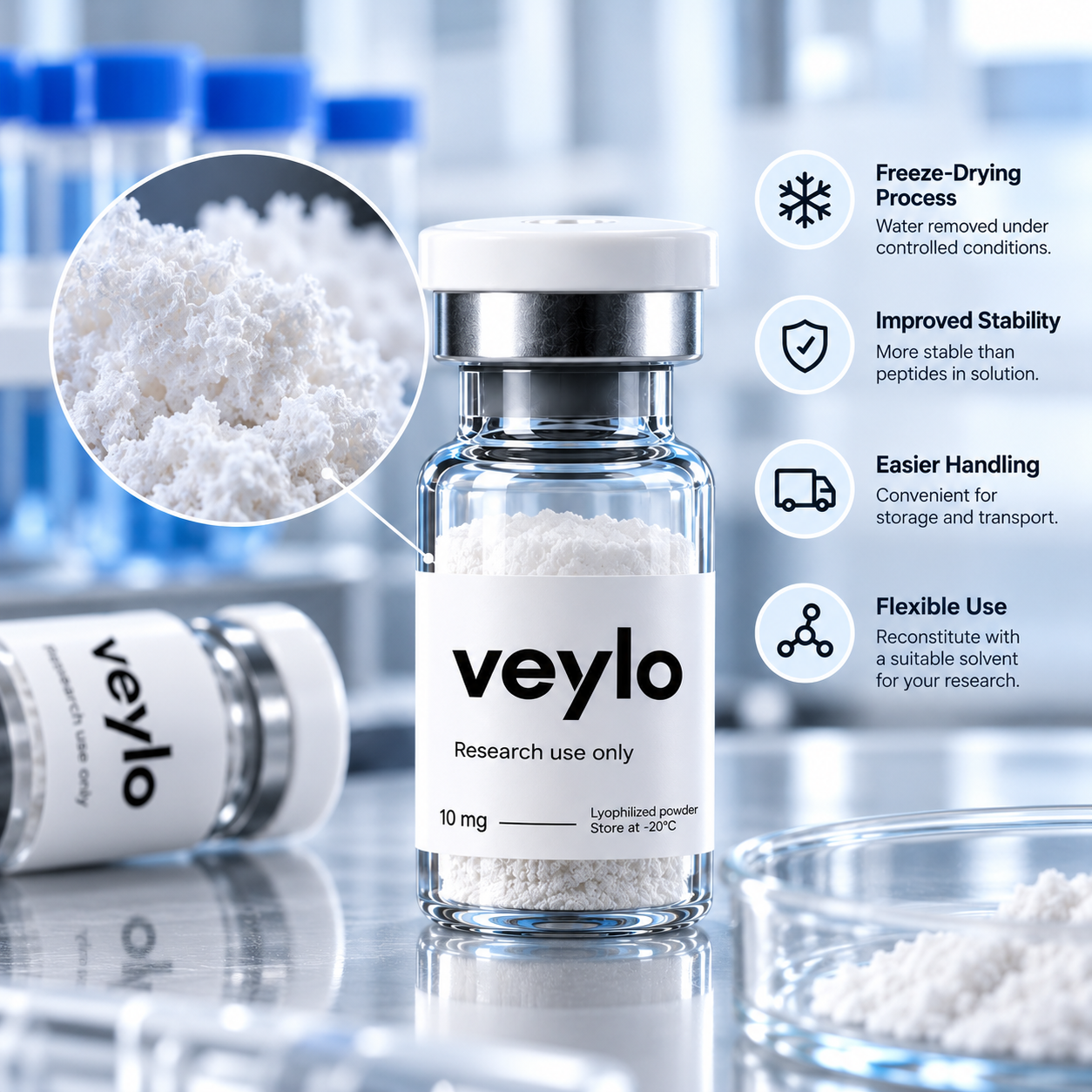
Lyophilized peptides are common in laboratory research because freeze-drying can help improve material stability during storage and handling. Many research peptides are supplied in this form as a dry powder or solid residue inside sealed vials.
Understanding what lyophilization does, why it is used, and how it affects research materials is important for maintaining consistency in peptide-based experiments.
This article explains the basics of lyophilization, its role in peptide research, and the key considerations researchers should keep in mind when working with lyophilized materials.
Lyophilization is a freeze-drying process used to remove water from a material under controlled conditions.
In general, the process involves:
The goal is to produce a dry material that is more stable than the same compound in solution.
For peptides, lyophilization is often used because water can contribute to degradation reactions, including hydrolysis and other chemical changes.
Peptides can be sensitive to environmental conditions. Temperature, moisture, oxygen, and pH may all affect their stability.
Lyophilization is commonly used in research settings for several reasons:
Removing water can reduce the rate of certain degradation processes.
For many peptides, the dry form is more stable than the dissolved form when stored under suitable laboratory conditions.
Dry peptide materials are generally easier to package and transport than liquid formulations.
This can help reduce instability during shipping and routine laboratory use.
Researchers may reconstitute the peptide in a solvent appropriate for their experimental design.
This gives laboratories more flexibility in preparing working solutions based on the needs of a particular study.
Lyophilized peptides do not always look the same.
Depending on the peptide sequence, formulation, and freeze-drying conditions, the material may appear as:
These physical differences do not automatically indicate differences in purity or quality.
Appearance alone is not enough to evaluate the material. Proper analytical testing is still necessary to confirm characteristics such as identity and purity.
Water is involved in many chemical processes that can alter peptides over time.
By reducing water content, lyophilization may help limit:
However, lyophilization does not make a peptide permanently stable.
A dry peptide can still be affected by:
So while lyophilization is helpful, it is only one part of maintaining sample integrity.
Even after freeze-drying, some residual moisture may remain in a peptide sample.
The amount depends on the material and the drying process used.
Residual moisture matters because too much remaining water can reduce storage stability, especially for moisture-sensitive peptides.
Laboratories may use analytical methods such as Karl Fischer titration or other validated techniques when moisture content is an important quality attribute.
For routine research use, the key point is that “lyophilized” does not necessarily mean completely dry under all conditions.
A peptide in dry form usually behaves differently from the same peptide in solution.
In a lyophilized state, the peptide is generally less chemically reactive because there is little available water to support certain degradation pathways.
After reconstitution, the peptide interacts with the solvent, dissolved oxygen, buffer components, and container surfaces.
This can increase the likelihood of:
Because of this, many peptides are more stable before reconstitution than after.
Researchers should therefore treat the solution phase as a separate stability consideration.
Lyophilized peptides still require proper storage.
Common laboratory considerations include:
Many lyophilized peptides are stored under refrigerated or frozen conditions, often around -20°C or according to compound-specific guidance.
Exposure to humid air may allow the peptide to absorb water, which can reduce stability.
Some peptides may be sensitive to light and should be kept in opaque or protected containers when necessary.
Repeatedly opening a vial can expose the sample to moisture and temperature fluctuations.
Appropriate storage depends on the specific peptide and available stability data. There is no universal condition that applies equally to every compound.
Reconstitution is the process of dissolving a lyophilized peptide into a chosen solvent.
This step can influence research outcomes because peptides may behave differently depending on the solvent system used.
Researchers may consider:
Improper reconstitution can lead to incomplete dissolution, precipitation, or instability.
Because each peptide has different chemical properties, reconstitution should be based on the requirements of the specific compound and the research protocol.
Lyophilization itself is a processing method, not a direct measure of peptide quality.
A lyophilized peptide can still vary in:
This is why analytical characterization remains essential.
High-Performance Liquid Chromatography (HPLC), Mass Spectrometry (MS), and related analytical techniques may be used to assess the material before or after storage.
A vial containing a clean white powder may appear acceptable visually, but appearance does not confirm the actual composition of the sample.
For laboratories working with lyophilized peptides, good documentation supports reproducibility and traceability.
Useful records may include:
This information can help identify why research results may differ between samples or across time.
Several assumptions can cause confusion in research settings.
Not true. Freeze-drying may improve stability, but the peptide can still degrade under poor storage conditions.
Not true. Peptides can vary significantly in identity, purity, formulation, and physical behavior even if they look similar.
Not true. Lyophilization does not confirm purity or identity. These require analytical testing.
Not true. Reconstitution changes the chemical environment and may affect short-term or long-term stability.
Lyophilized peptides are widely used in laboratory research because freeze-drying can help reduce water-related degradation and support more stable storage conditions.
Even so, lyophilization is not a guarantee of quality or indefinite stability. Researchers still need to consider moisture exposure, temperature, light, reconstitution conditions, and analytical characterization.
A clear understanding of how lyophilized peptides are prepared and handled helps support better experimental consistency and more reliable laboratory outcomes.
Research Use Disclaimer: This article is intended for educational and scientific informational purposes only. Lyophilized peptides discussed here are presented in the context of laboratory research materials only. Nothing in this article should be interpreted as medical advice or as guidance for human or veterinary use.