Third-party testing plays an important role in evaluating the identity, purity, and analytical characteristics of research peptides. As laboratories increasingly rely on synthetic peptides for biochemical and molecular investigations, independent verification can help provide additional confidence in the materials used in scientific experiments.
Research peptides may contain impurities, degradation products, or unexpected molecular components that can influence experimental outcomes. Analytical testing helps researchers identify these characteristics and assess whether a sample meets defined research requirements.
This article explores how third-party peptide testing works, which analytical methods are commonly used, and why independent laboratory verification matters for reliable scientific research.
Third-party peptide testing refers to analytical testing performed by a laboratory that operates independently of the material supplier or manufacturer.
The purpose is to provide an additional evaluation of specified characteristics without relying exclusively on testing reported by the organization supplying the peptide.
An independent laboratory may analyze peptide samples to determine characteristics such as:
The specific information obtained depends on the tests requested and the analytical methods used.
Independent testing does not automatically establish that a sample meets every possible quality requirement. Its value depends on the laboratory’s competence, analytical procedures, sample traceability, and supporting documentation.
Scientific research depends on the reliability of the materials used in experiments.
When a research peptide contains unexpected compounds or differs from its intended molecular structure, experimental observations may become difficult to interpret.
Independent testing can help identify potential inconsistencies and provide additional analytical evidence.
Peptides are defined by their amino acid sequences and chemical structures.
Two materials may look identical while containing different molecular compounds.
Independent identity testing helps researchers evaluate whether a sample is consistent with the intended peptide.
Peptide synthesis and processing can introduce unwanted components.
Independent purity testing can help characterize the relative abundance of detectable impurities.
Experimental reproducibility depends partly on the consistency of research materials.
When samples are appropriately characterized, researchers can better evaluate whether differences between experiments may be associated with material composition.
Independent analytical reports can supplement supplier-provided Certificates of Analysis.
These documents provide additional evidence about the characteristics of the samples tested.
The testing process typically begins when a laboratory receives a peptide sample for analysis.
Although procedures vary, several general stages are common.
The laboratory records information associated with the submitted material.
This may include the sample name, batch number, identification code, and requested analytical tests.
Accurate identification is essential for connecting the results to the correct research material.
Different analytical techniques are suitable for evaluating different characteristics.
The laboratory selects or develops methods based on the peptide’s properties and the objectives of the analysis.
The sample is examined using the selected analytical instruments.
Depending on the investigation, these may include chromatographic systems, mass spectrometers, or other laboratory equipment.
The laboratory processes the analytical data and evaluates the measured results.
The interpretation depends on the testing methods, reference materials, and predefined analytical criteria.
A final report summarizes the tests performed and their findings.
Supporting information may include chromatograms, spectra, analytical conditions, and sample identification details.
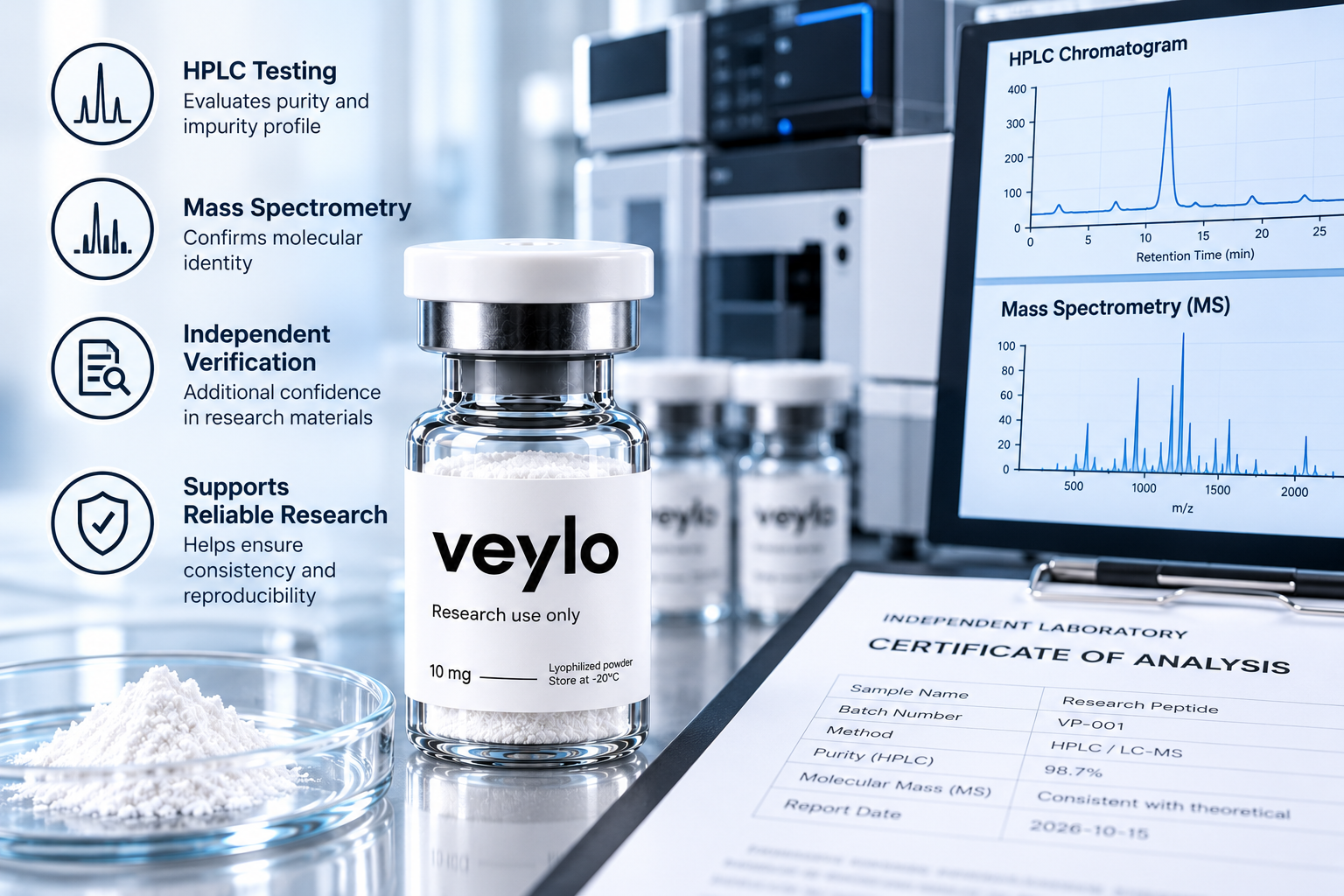
High-Performance Liquid Chromatography is one of the most commonly used methods for evaluating peptide purity.
HPLC separates components within a sample according to their interactions with a stationary phase and a flowing liquid.
As components leave the chromatographic column, a detector records their responses.
The resulting chromatogram provides information about the detectable components present in the sample.
A laboratory may report peptide purity using a peak-area percentage.
For example, a reported result of 98.5% HPLC area purity generally indicates that the principal peak accounts for 98.5% of the integrated detector response included in the calculation.
However, this percentage should not automatically be interpreted as the percentage of total sample mass consisting of the target peptide.
Certain impurities may not be detected by the selected method, while overlapping components may complicate the interpretation.
For this reason, HPLC purity is an important analytical measurement but not a complete assessment of peptide quality.
Mass spectrometry is commonly used to support peptide identification.
This analytical technique measures the mass-to-charge ratios of ions generated from a sample.
For peptide research, mass spectrometry can help determine whether the observed molecular mass is consistent with the expected compound.
Each peptide has a theoretical molecular mass associated with its chemical composition.
Researchers can compare experimental measurements with calculated values to help characterize the sample.
However, compounds with different structures can sometimes have identical or very similar molecular masses.
Therefore, molecular mass agreement alone may not conclusively establish the intended amino acid sequence.
Additional analytical methods may be required when greater structural confirmation is necessary.
Liquid Chromatography–Mass Spectrometry combines chromatographic separation with mass spectrometric detection.
This approach allows researchers to examine separated sample components while also obtaining mass-related information.
LC-MS can be useful for:
By combining complementary information, LC-MS can provide a more detailed understanding of sample composition than either technique alone in certain applications.
However, the reliability of the results still depends on the analytical method and its suitability for the intended purpose.
Peptide impurities can originate from several stages of synthesis, purification, processing, and storage.
Different impurities may influence analytical results or interfere with experimental observations.
Peptide synthesis involves connecting amino acids in a defined sequence.
Incomplete reactions or unwanted chemical modifications may produce related compounds.
Examples include truncated sequences, deletion products, and chemically modified peptides.
Residual solvents, reagents, or other processing materials may remain after manufacturing.
The presence and significance of these compounds depend on the synthesis and purification methods used.
Peptides may undergo chemical changes during storage or handling.
Oxidation, hydrolysis, deamidation, and other reactions can produce degradation products.
Independent analytical testing may help detect and characterize some of these components.
Some laboratory research applications require additional testing beyond chemical purity and molecular identity.
Depending on the experimental system, researchers may need information about bacterial endotoxins, microbial contamination, or other biological contaminants.
These characteristics require appropriate testing methods.
For example, an HPLC purity report does not establish that a material is sterile or free from bacterial endotoxins.
Similarly, mass spectrometry results supporting molecular identity do not independently establish microbiological quality.
Researchers should identify the quality attributes relevant to their experimental application and evaluate whether suitable tests have been performed.
Both manufacturer testing and independent laboratory testing can provide useful analytical information.
The primary difference is the relationship between the laboratory performing the analysis and the organization supplying the material.
Manufacturers may use internal laboratories to evaluate materials during synthesis, purification, and quality control.
Internal testing can provide valuable information about production consistency and material characteristics.
Independent laboratories operate separately from the manufacturer or supplier.
Their analysis can provide an additional source of analytical evidence.
However, independent testing is not automatically more accurate than manufacturer testing.
The scientific reliability of either approach depends on factors such as method suitability, laboratory competence, quality controls, and the integrity of reported data.
A useful analytical report should clearly identify what was tested and how the results were obtained.
Depending on the test, important information may include:
A report should also make clear which characteristics were not evaluated.
For example, a certificate reporting HPLC purity should not be interpreted as evidence that all possible contaminants were assessed.
ISO/IEC 17025 is an international standard that establishes requirements for the competence, impartiality, and consistent operation of testing and calibration laboratories.
Accreditation to this standard can provide additional confidence in a laboratory’s technical capabilities.
The standard addresses areas such as:
However, accreditation applies to the specific activities listed within the laboratory’s scope of accreditation.
A laboratory accredited for one analytical method is not necessarily accredited for every type of peptide analysis.
Researchers should therefore evaluate whether the relevant testing activities are included within the laboratory’s accreditation scope.
Peptide materials produced in separate batches may differ in impurity profiles, residual components, or stability characteristics.
Even when two batches contain the same intended peptide, variations in synthesis, purification, or handling may affect analytical results.
Batch-specific testing helps connect analytical findings to identifiable material.
For example, an analytical report issued for one batch should not automatically be used to characterize a different batch.
Researchers should verify that the sample identifier and batch number on a testing report correspond to the material being evaluated.
Independent test results are only meaningful when the tested sample can be reliably connected to the material under investigation.
Sample traceability involves documenting the identity and handling history of a material.
A chain-of-custody record may include information about sample collection, transfer, receipt, storage, and analysis.
These records help establish which sample was tested and who handled it during the process.
Importantly, a laboratory may accurately analyze a submitted sample without independently confirming that it represents an entire production batch.
This distinction should be considered when interpreting third-party testing claims.
Several assumptions can lead to incorrect interpretations of peptide testing results.
Not necessarily. Testing establishes only the characteristics evaluated by the selected methods.
Not necessarily. Purity and molecular identity are different analytical attributes.
Not true. Methods, equipment, detection limits, and reporting practices may differ.
Not necessarily. Results apply to the specific sample analyzed, and broader conclusions depend on representative sampling and traceability.
Not necessarily. Accreditation must be evaluated in relation to the laboratory’s specific scope.
Understanding these distinctions helps researchers interpret analytical documentation more accurately.
Reliable laboratory testing requires analytical procedures that are suitable for their intended purpose.
Method validation evaluates whether an analytical procedure can consistently provide meaningful results.
Important characteristics may include:
Specificity: The ability to evaluate the intended analyte in the presence of other components.
Accuracy: How closely a measured result agrees with an accepted reference value.
Precision: The consistency of results obtained from repeated measurements.
Detection Limit: The lowest amount of an analyte that can be detected under defined conditions.
Quantitation Limit: The lowest amount that can be measured quantitatively with suitable performance.
These principles are described in international analytical validation guidance, including ICH Q2(R2).
Understanding method performance is important because the same sample may produce different results when analyzed using methods with different capabilities.
Reproducibility is essential in scientific investigation.
When researchers use poorly characterized materials, it can become difficult to determine whether differences in experimental outcomes result from biological processes or variations in sample composition.
Independent testing can reduce some of this uncertainty by providing documented analytical information.
For example, researchers comparing results across experiments may benefit from knowing whether different peptide samples have consistent molecular identities and impurity profiles.
Maintaining batch-specific reports alongside experimental records can support more transparent data interpretation.
However, reproducibility also depends on experimental design, controls, equipment, procedures, and many other factors beyond material testing.
Independent verification provides useful information, but it has limitations.
First, laboratory results reflect the characteristics of the submitted sample at the time of testing.
Second, analytical methods can detect only the components and characteristics within their capabilities.
Third, different laboratories may use different methods, creating potential differences in reported results.
Finally, chemical identity and purity do not establish clinical safety, therapeutic effectiveness, or regulatory approval.
Researchers should interpret independent testing as one component of a broader material-characterization process rather than a universal guarantee of quality.
Third-party peptide testing provides an important additional source of analytical evidence for laboratory research.
Independent examination of molecular identity, chromatographic purity, impurities, and other relevant characteristics can help researchers better understand the materials used in scientific experiments.
Techniques such as HPLC, mass spectrometry, and LC-MS contribute complementary information about peptide composition.
However, meaningful verification requires more than a reported purity percentage. Laboratory competence, analytical method suitability, batch traceability, and transparent documentation are also essential.
By understanding both the value and limitations of independent testing, researchers can make better-informed decisions about material characterization and support more reliable experimental investigations.
Research Use Disclaimer: This article is intended exclusively for educational and scientific informational purposes. Research peptides discussed here are presented for laboratory research only. Third-party analytical testing does not establish medical approval, clinical safety, or suitability for human or veterinary administration. Nothing in this article constitutes medical advice or treatment guidance.