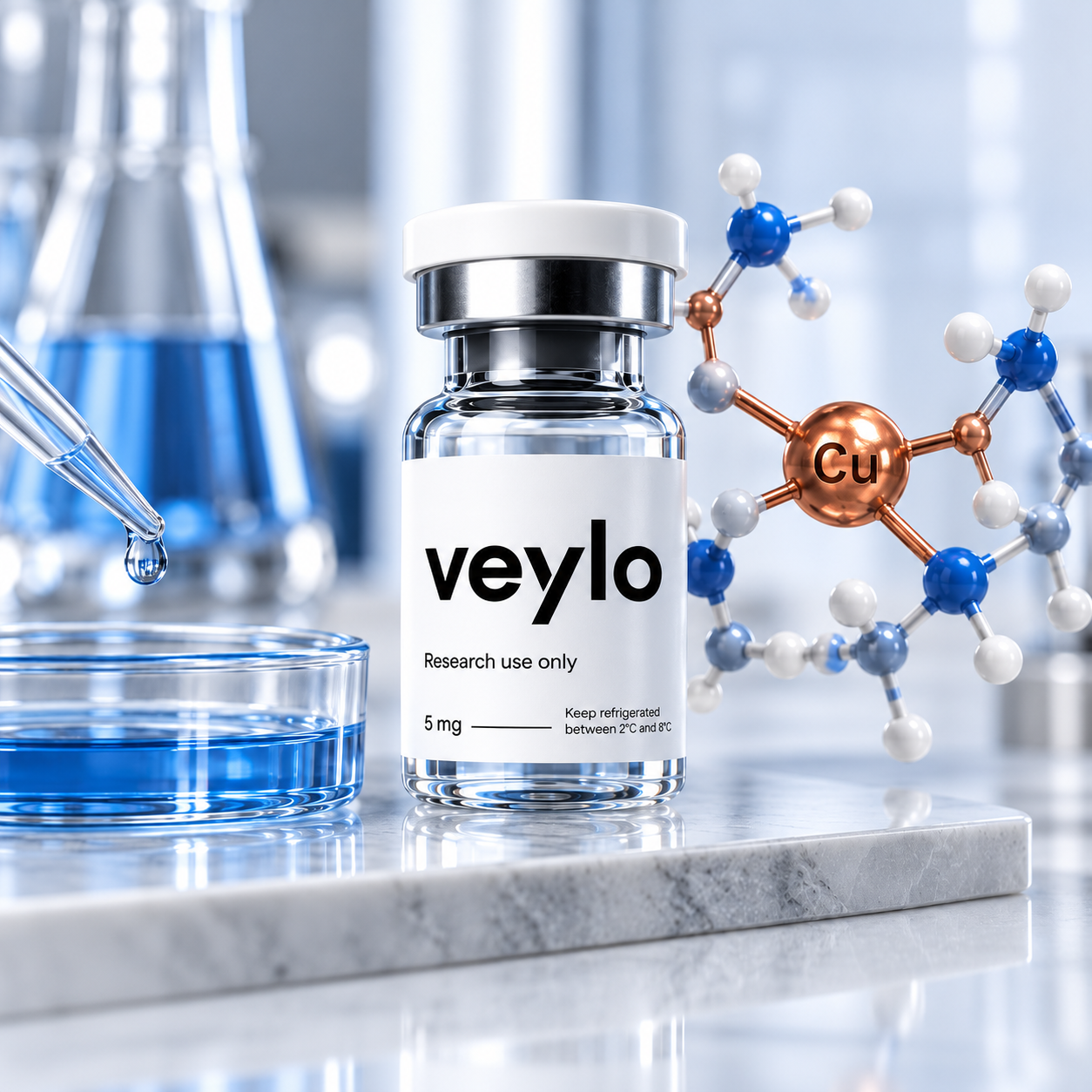
GHK-Cu is a peptide-copper complex that has been studied in several areas of laboratory research, especially in relation to skin biology, extracellular matrix activity, and cellular signaling.
Researchers have examined GHK-Cu in preclinical settings to better understand how it interacts with biological systems involved in tissue maintenance, remodeling, and repair. Because of these research interests, it is often discussed in studies related to dermal structure, wound environments, and hair follicle biology.
This article provides a research-focused overview of GHK-Cu, its basic characteristics, and the main scientific areas in which it has been investigated.
GHK-Cu stands for glycyl-L-histidyl-L-lysine copper. It is a naturally occurring copper-binding tripeptide composed of three amino acids:
When this peptide binds with copper ions, it forms the GHK-Cu complex.
In scientific literature, GHK-Cu has been examined because copper is an important trace element in many biological processes, including enzyme activity, connective tissue biology, and cellular signaling. The peptide component may help transport or present copper in ways that influence laboratory-observed biological responses.
GHK-Cu has drawn attention because of its reported involvement in several biological processes that are relevant to tissue research.
Areas of interest include:
Much of this work remains preclinical or exploratory. While findings may be interesting from a research standpoint, they should not be interpreted as proof of clinical effectiveness in humans.
One of the most common areas of GHK-Cu research involves skin-related cellular activity.
The skin contains a complex extracellular matrix made up of structural proteins, signaling molecules, and support components that contribute to its integrity and function. Researchers have studied whether GHK-Cu may influence laboratory markers associated with dermal remodeling.
Collagen is a major structural protein in connective tissue. It plays a central role in tissue support and resilience.
In cell-based and preclinical studies, GHK-Cu has been examined for its relationship to:
Fibroblasts are cells involved in producing and organizing components of the extracellular matrix. Some studies suggest that GHK-Cu may influence fibroblast-related activity under laboratory conditions.
Researchers have also explored whether GHK-Cu affects other matrix-related proteins, including elastin and glycosaminoglycan-associated processes.
These findings are useful for understanding peptide-cell interactions, but they do not automatically translate into clinically verified outcomes.
GHK-Cu has also been investigated in studies involving tissue repair models and wound-related biology.
Tissue repair is a complex process involving:
Researchers have used experimental systems to evaluate whether GHK-Cu influences some of these processes.
In laboratory environments, GHK-Cu has been studied for its effects on fibroblast activity, which may be relevant to tissue organization and matrix remodeling.
Some research has also examined the peptide in relation to angiogenesis, the process through which new blood vessels form from existing ones. Vascular responses are important in tissue maintenance and repair, and scientists have investigated whether GHK-Cu has any measurable effect on related signaling pathways.
Tissue remodeling depends on a balance between matrix production and matrix breakdown. Researchers have explored whether GHK-Cu may affect this balance through interactions involving matrix metalloproteinases and related molecular systems.
These observations remain part of ongoing research and should be interpreted within the context of controlled experimental models.
Another area of interest involves hair follicle biology.
Hair follicles are dynamic mini-organs influenced by signaling pathways, local tissue environment, vascular support, and inflammatory factors. Researchers have studied GHK-Cu in relation to:
Some experimental findings suggest that GHK-Cu may affect molecular signals relevant to follicle health and local tissue maintenance. However, the available evidence varies in quality and design, and more controlled research is needed to clarify its biological role.
From a research standpoint, this remains an active area of investigation rather than a settled conclusion.
Inflammation is a regulated biological response involving multiple cell types, mediators, and signaling molecules.
Researchers have investigated whether GHK-Cu interacts with inflammatory pathways under laboratory conditions. Some studies suggest it may influence markers associated with inflammatory activity and oxidative stress.
Understanding these interactions may help clarify how tissue environments respond to injury, stress, or remodeling signals.
However, inflammatory signaling is highly complex, and responses observed in isolated models do not necessarily predict whole-system outcomes in humans.
Oxidative stress refers to an imbalance between reactive molecular species and the biological systems that regulate them.
Because copper is involved in enzyme systems and redox biology, GHK-Cu has also been studied in relation to oxidative stress responses.
Research interest in this area includes:
These studies may help researchers understand broader biological patterns, though the interpretation depends heavily on the model, dosage, and experimental conditions used.
As with many peptides, how GHK-Cu is formulated can influence how it behaves in a research environment.
Scientists may examine factors such as:
Material handling is important because peptide degradation, contamination, or altered chemical form can affect research outcomes.
For this reason, analytical characterization remains an important part of peptide-based laboratory work.
Reliable research depends on using well-characterized materials.
When studying GHK-Cu, researchers may consider:
Analytical methods such as High-Performance Liquid Chromatography (HPLC) and Mass Spectrometry (MS) may be used to support sample characterization.
A reported purity result can be useful, but it does not independently establish biological function, sterility, or suitability for every research application. Proper documentation and traceability remain essential.
Although GHK-Cu has been widely discussed in scientific and cosmetic research settings, several limitations remain.
A significant portion of the literature involves in vitro or exploratory studies rather than large, well-controlled human trials.
Different experiments may use different concentrations, formulations, and biological models, making comparisons difficult.
Although several pathways have been proposed, the exact mechanisms through which GHK-Cu produces observed effects remain under investigation.
Positive findings in a laboratory model do not automatically establish real-world therapeutic value.
These limitations are important when reviewing claims about GHK-Cu and when evaluating its relevance for future research.
GHK-Cu is a copper-binding tripeptide complex that continues to attract interest in laboratory research involving skin biology, extracellular matrix activity, tissue remodeling, inflammatory signaling, and hair follicle studies.
Its biological relevance appears to be linked to the interaction between peptide signaling and copper-associated cellular processes. Experimental findings suggest that it may influence several pathways of scientific interest, particularly those involving tissue organization and maintenance.
At the same time, much of the current understanding comes from preclinical or exploratory research. Continued investigation is needed to better define its mechanisms, limitations, and significance across different biological systems.
Research Use Disclaimer: This article is provided for educational and scientific informational purposes only. GHK-Cu discussed here is presented in a research context only. Nothing in this article should be interpreted as medical advice, treatment guidance, or a claim regarding human or veterinary use.